

⊹ the circe brief ⊹
Since graduating in May, this is probably the question we get asked most: was it worth it?
Kinda rude. We did just spend two years of our lives getting these degrees. Maybe don’t ask that question to a new grad while she’s still wearing her cap and gown?
BUT.
It’s fair.
An MBA is a massive investment, and nobody wants to spend two years and a small fortune on a very expensive identity crisis.
Anna came to Berkeley Haas to pivot into healthcare VC. I came to start a company, learn the fundamentals I didn’t yet have, and, if we’re being honest, give myself a little more ~courage~ before quitting my job and building something from scratch.
We both graduated with a much clearer idea of what we wanted. Neither of us ended up exactly where we expected.
And as it turns out, that might be the whole point.
an mba is like an all-you-can-eat buffet, and you’re on glp-1
Many people arrive to b-school with an intense plan. They have color-coded spreadsheets, recruiting timelines, and sometimes, color-coded spreadsheets of their recruiting timelines.
Having a plan is great. But there’s value in finding out that your plan is wrong before you spend the next decade executing it.
You have access to the entire buffet: investing, operating, consulting, building a company, working at an early-stage startup, or entering an industry you’ve never touched. But you only have two years, and you can’t try everything.
You don’t want to fill up on rice, but if you only eat beef because you’ve already decided you’re a beef person, you might never discover that you actually love shrimp.
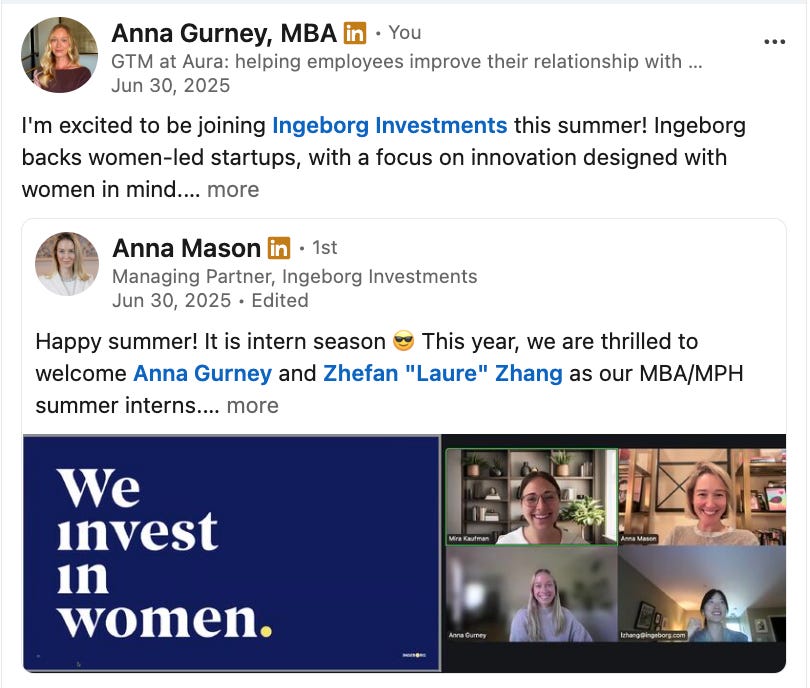
Let’s take Anna: She came into her MBA/MPH intending to move into healthcare venture capital. And she did! But, spending time in the VC ecosystem helped her realize that she was more interested in building and operating on the startup side in the near term.
What if, instead of treating business school as a machine for getting the job you already decided you want, you treated it as an opportunity to test the things you think you want?
So, sample things you wouldn’t normally order.
Sometimes you confirm your hypothesis. Sometimes you disprove it.
Both are good outcomes. In fact, disproving a hypothesis might save you years of wondering “what if?”
Of course, you only have one stomach and two years, so you can’t try everything.
Our take: Enter an MBA with intention, but leave room to surprise yourself. And give yourself at least one hypothesis to disprove. Challenge something you think is true about yourself. Even something as small as “I hate marketing” can be challenged by taking a class or starting a project.
a startup sandbox with training wheels
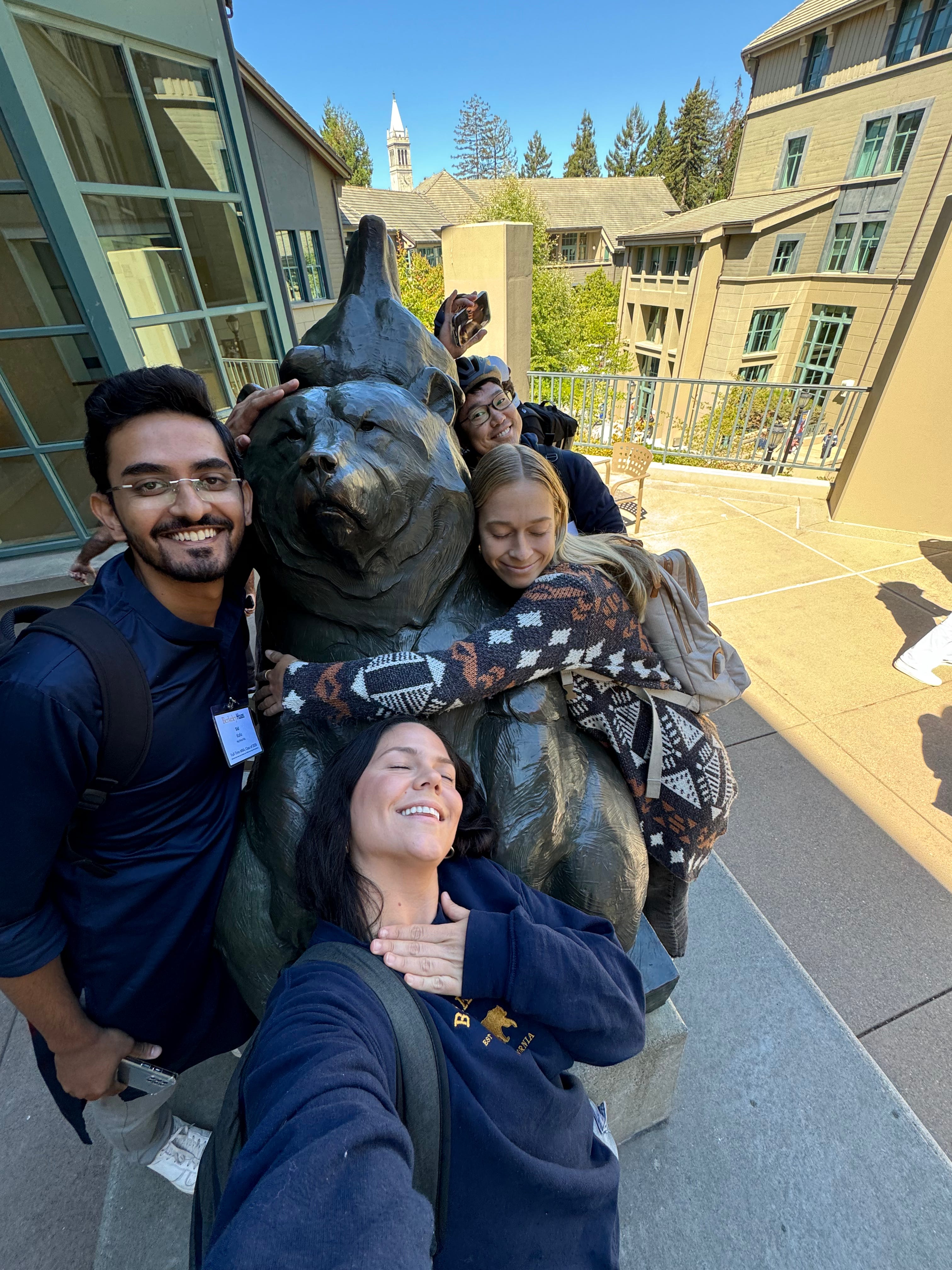
Like Anna, I came into the MBA with a question: what does it take to start a company?
I knew I wanted to build something. I wasn’t yet sure what kind of business I wanted to build, whether I was prepared to quit my job and face the reality of founder life, or what I would actually have to give up to do it.
For me, Haas was a two-year runway to experiment with entrepreneurship.
I had access to resources like Berkeley SkyDeck and the Sutardja Center for Entrepreneurship, and I received several grants of non-dilutive funding through the school.
I built, pitched, sold, learned how a business operates (and made plenty of mistakes) with a support system around me. And worse case, if my startup failed? Well, then I’d have a business degree from a top school.
And I learned A LOT. Sales. Customer discovery. The mechanics of getting from zero to one. Hiring. Accounting. Figuring out what someone will actually pay for. All the unsexy operational stuff that sits between having an idea and running a profitable business.
I even became a complete SF cliche and learned how to DJ (along with like, 50 other classmates. One thing is for sure, our graduating class will never be in short of a DJ for their parties.)

BUT the 2 most important lessons I learned while building a startup in school:
For me, financial upside alone does not justify building a company. I don’t want to start just any business because entrepreneurship sounds exciting, because I want to be a millionaire, or because I want to have “3X Founder” on my LinkedIn tagline.
I ONLY want to work on something if I genuinely cannot leave it alone. A problem that’s interesting enough that I want to solve it, even when the work gets repetitive, the sales calls go nowhere, and nobody is congratulating me for working on it.
That is a very different standard from simply wanting to start a company.
I can build a company. Seems silly but this is probably the biggest takeaway. I don’t need to know everything about an industry before starting a business in it. I need to understand what I don’t know, how to validate an opportunity, how to get the first customers, which fundamentals I need to learn, and who I need to hire or ask for help.
I literally didn’t know what VC was when I started the program. Six months later, I was pitching VCs and helping negotiate company terms.
You do not need an MBA to start a business. Obviously. But after this experience, I feel confident that I could take an idea in a field I didn’t know deeply, work out how to learn what I needed, and build from there.
For me, that confidence alone was a huge return on the investment.
are we experts on corporate finance? no. but we know enough to be dangerous
We won’t sugarcoat it: some business school classes can be a joke.
A lot of the material is available online. And even at top-10 business schools, some of the cases are OLD (I’m talking Coca-Cola vs. PepsiCo) and the quality of the classes varies enormously. And with AI changing how we do business, some of the cases and classes are becoming completely obsolete.
We won’t pretend that sitting through a lecture on corporate finance is some irreplaceable educational experience.
But there’s value in building a foundational vocabulary across finance, accounting, operations, real estate, and strategy. You won’t become a specialist in every industry. But an MBA will give you the ability to talk to said specialists, understand enough to ask good questions, and recognize when something doesn’t add up.
For example: me buying out my leased car.
The dealership tried to slip in all sorts of fees and charges. Between my negotiations class and an understanding of interest rates, loan terms, and taxes, I worked out what was legit and what was ~creative accounting~
(It all worked out, but now car dealerships are a triggering topic for me. Did I just use our newsletter as an excuse to vent about it? maybe)
The point is that business school gave us enough context to walk into a room where someone had more expertise than we did and hold our ground.
That changes how you negotiate, how you evaluate opportunities, and how you make decisions. You stop being intimidated by an unfamiliar subject and start figuring out which questions you need answered.
It also changes how you see the world. I find myself noticing business opportunities in places I would have overlooked before, connecting things happening in the market to broader trends, and thinking about the business mechanics behind what I see online.
People have told us that we look, sound, and act different since starting the program. I think they’re right. We think differently now.
Part of that comes from the curriculum, but a lot of it comes from putting yourself in rooms where you don’t know the answer, learning quickly, and realizing that you can figure things out.
The degree gives you a vocabulary and some credibility. Doing the work gives you the confidence.
your network is your personal wikipedia
We know, we know. Every MBA program tells you that the network is the most valuable part of the degree.
… but it’s true.
You spend two years surrounded by ambitious people from all over the world who are deliberately investing in themselves. Some have spent years in big tech. Some have already built companies. Some are investors, operators, or early employees at startups. Some are trying to figure out what the hell they want to do next.
They’re people we’d hire. And they know other incredible people.
Imagine having your own personal Wikipedia that you can grab coffee with. Need to understand private equity? Seb spent years working in it. Need a warm intro to an investor? Ashley already raised $2M before school, let me just text her. Considering a job at a company I’ve never heard of? Oop, Sarah used to work there, she can tell me what it’s actually like inside.
Of course, access is only part of it. The magic is that these are people you actually know (and love!) You’ve studied, partied, and practically lived together. And you have a sense of kinship and a shared love for your school (Go bears + obligatory Stanford dig).


Alumni are the same: We’ve randomly met people like Helen Min while raising her fund, and seen people like Sammie Cohen at Social Currency and Jon Sebastiani behind Krave doing amazing things.
It’s pretty cool to look at what people from your own community are building and realize that you can pick up the phone and ask them how they did it.
That access compounds over time. Your classmates go on to start companies, join funds, hire teams, and build new networks of their own. The people you know today become the people opening doors for you five years from now, and vice versa.
Which brings us to the other part of the MBA that people love to make fun of...
ok, but why are you always partying
Hear us out: That’s kinda the point.
If you’re anything like me, a generic networking mixer can feel like a particularly cruel form of torture.
Now compare that with talking about the possibility of starting a company together over an Aperol spritz while skiing in the Austrian Alps.

Or finding yourself in a conversation that changes how you think about your career while in the dressing rooms getting ready to perform a drag show in front of 300 of your closest friends.

The MBA offers a structured opportunity to build a social circle with people who are also ambitious about their careers and intentional about investing in relationships.
That’s unusual. Most jobs don’t give you two years to build deep friendships with a few hundred people at exactly the same stage of life, all actively thinking about what they want to do next.
The parties aren’t a distraction from the network. A lot of times, they’re how you build it.
the part where the math gets ugly
Okay. Now for the caveats.
An MBA can be a brutally expensive decision. Tuition, living expenses, and the opportunity cost of two years of foregone salary can put the total economic cost into the hundreds of thousands of dollars.
My MBA was effectively free because of scholarships, which made the decision a lot easier for me. I would be a hypocrite if I ignored that when telling someone else whether business school is worth it.
There are ways to make the math work better, including scholarships, teaching and graduate student instructor positions, and other university funding opportunities. But you still need to take the financial commitment seriously.
And the ROI depends heavily on what you’re hoping to get out of the degree.
so this is our responsible PSA: An MBA is NOT for everyone.
If you want to move into investment banking or consulting and need the recruiting pipeline, the credential, and access to employers that recruit directly from campus, an MBA can make a lot of sense.
If you’re trying to fundamentally change your career trajectory, the ability to experiment can be enormously valuable.
But if you plan to stay doing the same work you were doing before (and work your way up the ladder), it’s much harder to justify the price tag. Similarly, if you’re trying to pivot in a way that does not seem drastic, usually you can do unpaid work or a side hustle which might open the same doors that an MBA would open (minus the $200k price tag).
You also need to be careful about coming in with such a rigid plan that you never take advantage of what the program offers. If you know exactly what you want and have no interest in exploring anything else, you might spend a lot of money on opportunities you never intended to use.
There is no universally correct answer. The question is what the degree will actually unlock for you, and whether those opportunities justify what you’re giving up.
so... was it worth it?
Yes, for both of us. But probably not for the reasons we would have given you on our first day, and DEFINITELY not for the reasons that I wrote about in my admissions essay (oops).
The biggest lesson seems obvious, but it’s truly the kind of lesson you have to learn by doing things that seemed impossible:
YOU CAN LITERALLY DO ANYTHING.
Business school happened to be a pretty incredible environment for proving that to ourselves.
If you’re considering an MBA, our advice is to think carefully about what you’re hoping to get out of it. The degree itself is not magic, and the classes might not change your life. But two years surrounded by people who know how to execute, with the resources to try things you have never tried and the freedom to change your mind, can be an extraordinary opportunity.
You might leave with the career you planned for. You might leave wanting something completely different.
Either way, you won’t spend the next ten years wondering what would have happened if you had tried.
And in our humble opinion, that’s worth more than getting the answer right the first time!
-Isa and Anna ⊹
upcoming events
⊹

nov 14 | girls run + brunch | RSVP
⊹
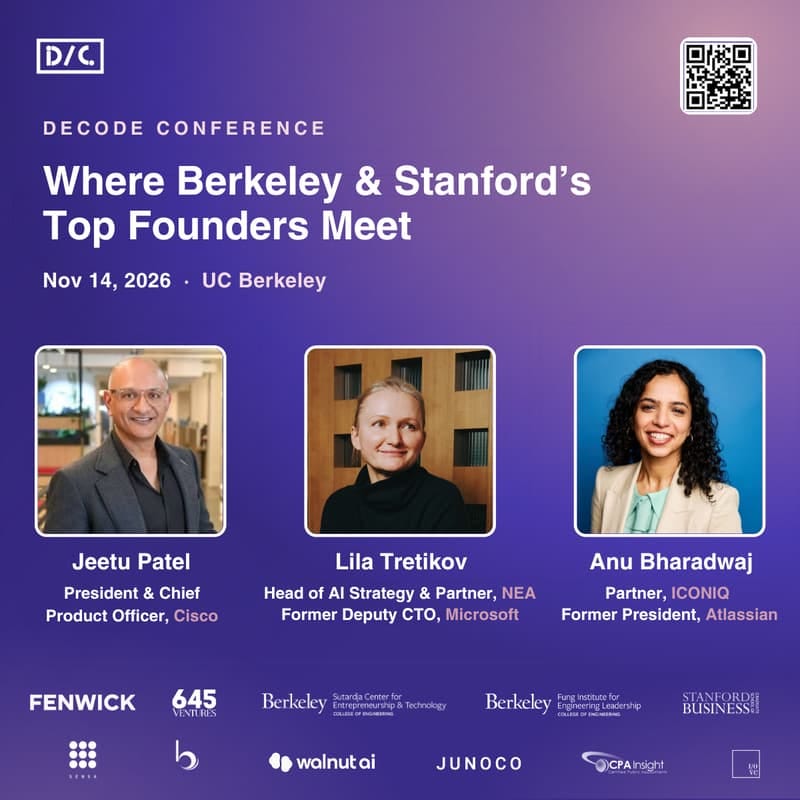
nov 14 | decode conference | RSVP
use code CIRCE for 35% off ticket prices for Decode!
⊹
check out our full calendar of events.
jobs by female founders
Chief of Staff, Head of Finance & Operations, Lead Product Designer, Product Manager, Growth — Allswell, SF (Respond to us if you want direct intro to Dawn!)
Forward Deployed Strategist — Coval, SF (Respond to us if you want direct intro!)
Sales/GTM — Riveter, SF (Respond to us if you want direct intro!)
Chief of Staff (& Others) — Complete, SF (Respond to us if you want direct intro!)
Design Engineer, Founding Engineer, Internships — LegalOS, SF (Respond to us if you want direct intro!)
Product Engineer, Research Engineer/Scientist, Senior BD & Ops Lead - World Labs, SF
Hardware, Civil & Electrical Engineers, Supply Chain Lead, BD - UNLIMITED, SF
Head of Engineering, Head of Sales, Product Engineer, SDR - Mintlify, SF
Software Engineer (Product, Infra), Lead Editor PM, Lead Data Scientist, Brand Design Lead, Head of Enterprise Marketing - Descript, SF/Remote
Product Manager, Senior ML Engineer, GTM Associate, Strategic Customer Success - Raspberry AI, NYC/Remote
Staff Software Engineer, Principal PM Patient Growth, Head of Member Growth & Retention, Strategic Partnerships - Pomelo Care, Remote
That’s all from us this week! We’re so happy to have you follow along in our journey, and if you want to officially be part of our community, you can apply here.